
About Me
Hello! I'm Donghui.
I am a Postdoctoral Research Associate at Princeton University working with Dr. Gabriele Villarini at Princeton University. I earned my Ph.D. from the University of Illinois Urbana-Champaign (2024) under the advisement of Dr. Ximing Cai.
My work advances large-scale hydrological and water resources modeling, with a specific focus on understanding and predicting hydrological extremes. I leverage machine learning, physically based modeling, and high-performance computing to transform complex human-water processes into decision-relevant insights.
I am currently exploring the usage of Agentic LLMs to close the "last mile" of risk communication. By combining state-of-the-art hydrological and hydraulic simulation outputs with generative AI, I aim to transform data-heavy model outputs into the actionable insights needed for real-world resilience.
When I'm not in research mode, you'll find me vibing to grunge.
Education
| Ph.D. | University of Illinois Urbana-Champaign | Civil and Environmental Engineering with Graduate Minor in Statistics |
2024 |
| M.Sc. | University of Illinois Urbana-Champaign | Civil and Environmental Engineering | 2020 |
| B.E. | Tsinghua University | Hydraulic Engineering | 2018 |
Selected Projects
Water Management Modeling for Large-scale Hydrological Modeling
This research includes a suite of machine learning models I developed and co-developed to establish empirical reservoir operation rules, which aims to better represent human water management in large-scale hydrological and water resources modeling frameworks. Better simulation of the important human dimension will significantly enhance the accuracy of streamflow simulations in managed river basins.
The foundational model is Generic Data-driven Reservoir Operation Model (GDROM), which is a coupled Hidden Markov Model and Decision Tree framework to extract reservoir operation rules from historical data. GDROM is designed to be generic and interpretable. Applying the GDROM to 400+ major reservoirs across CONUS, we identified real-world operation patterns across regions and reservoir types, which provides a critical step toward generalizing data-extracted empirical operation rules to data-scarce reservoirs. This series of work is published in Advances in Water Resources (2022) and Water Resources Research (2024).
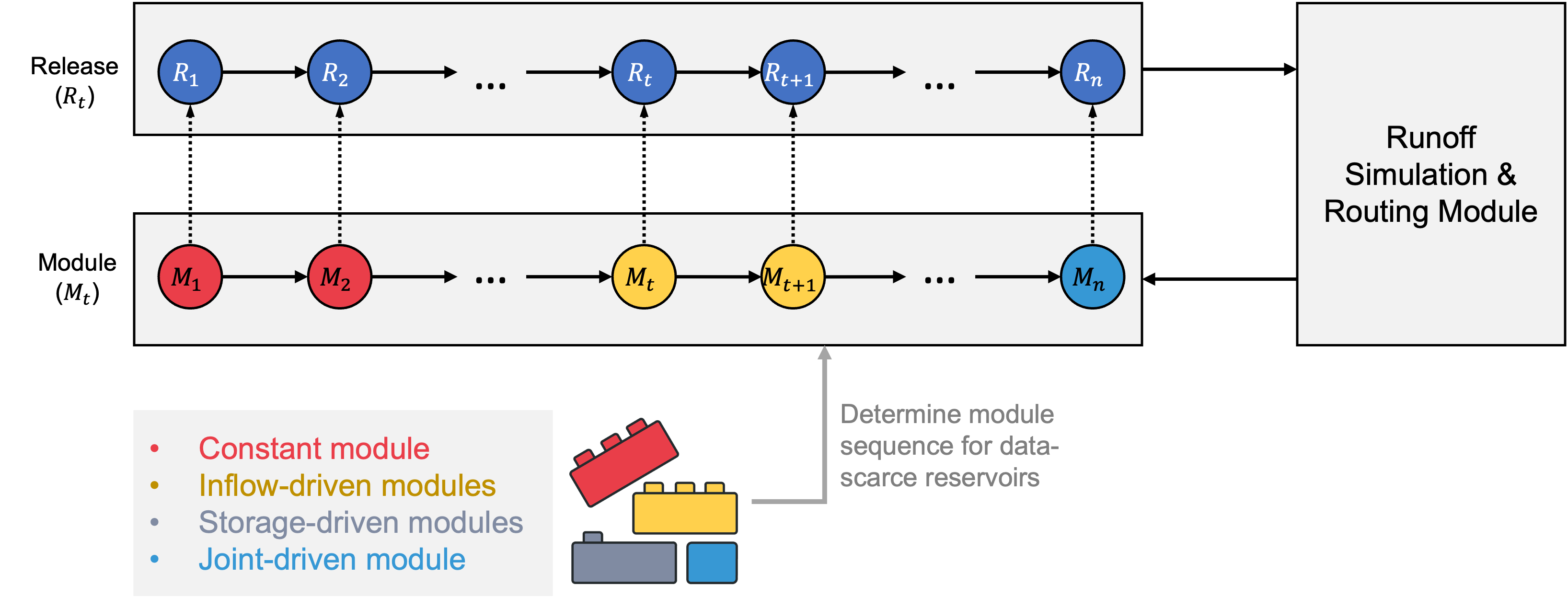
Based on GDROM and its revealed CONUS operation patterns, specifically the representative operation modules and their seasonal application and transition found in the WRR paper, I designed a practical and parsimonious approach to generalize data-extracted operation rules to data-scarce reservoirs. This work is published in Journal of Advances in Modeling Earth Systems (2026).
Technical Details & Publications
Coupled Hydrological and Water Management Modeling and Analysis
Following the development of our data-driven reservoir operation models, my followed research focuses on their integration into large-scale hydrological and water resources modeling frameworks. I systematically coupled the reservoir models with large-scale hydrological frameworks, progressing from offline one-way benchmarking studies to a fully two-way coupled large-scale modeling system.
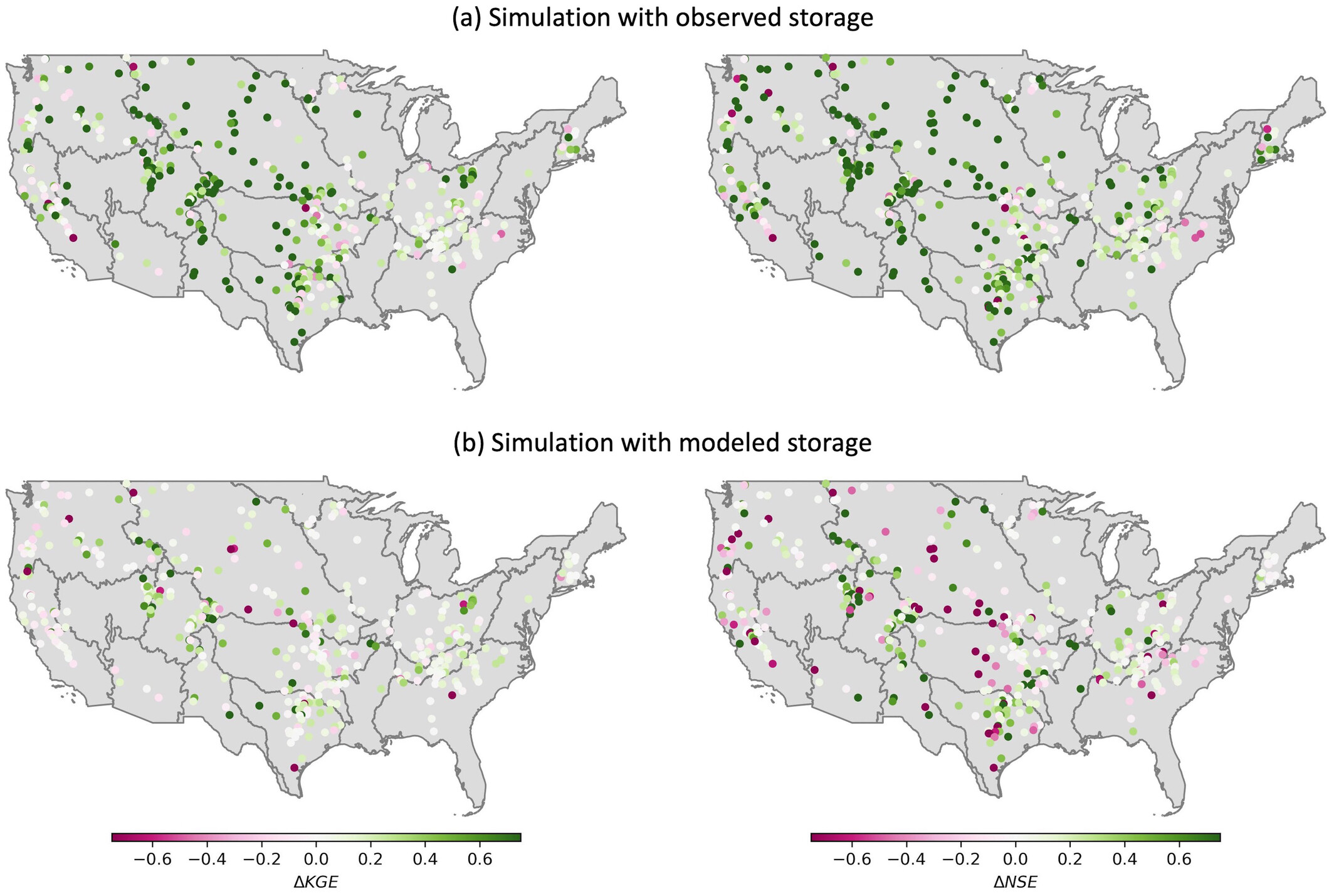
With GDROM in hand, I evaluated the performance gains achievable. In the one-way coupling study, I drove GDROM with National Water Model (NWM) retrospective streamflow simulations across the CONUS, replacing the NWM’s built-in reservoir rules at data-rich reservoirs. In other words, the hydrological component (NWM) and the reservoir operation component (GDROM) are run separately. The results demonstrated significant improvements in regulated streamflow simulation nationally, while also revealing an important modeling constraint: inaccurate reservoir inflow and storage simulation can offset the benefits of improved operation rules. This work is published in JAWRA Journal of the American Water Resources Association (2025).
One-way coupling is a critical first step, but the ultimate goal is to achieve a fully two-way coupled modeling system, where the hydrological and reservoir operation components interact with each other at each time step. Our first two-way coupling is led by my colleague A. Vora, coupling GDROM with a conceptual hydrological model at lumped watershed scale. This work is published in Water Resources Research (2024).
Extending the two-way coupling to finer resolution, I am currently implementing the model coupling with Princeton's GPU-accelerated rainfall-runoff-routing model, Tiger-HLM, at the hydrography90m ultra-high-resolution river network. This work is ongoing, and stay tuned for the code and results!
Technical Details & Publications
Large-scale Flood Inundation Mapping
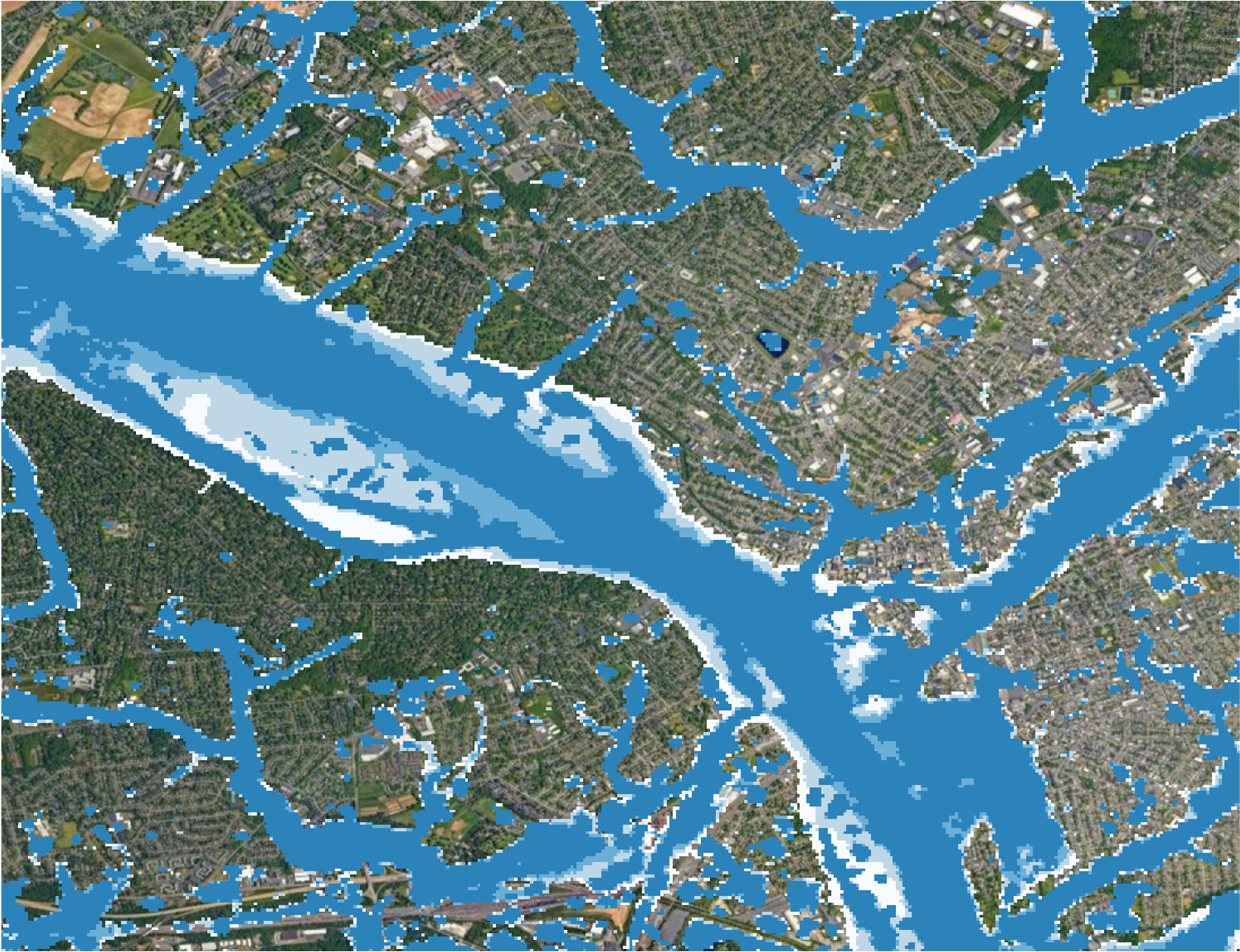
Leveraging the capabilities of advanced hydrological and hydrodynamic models, specifically Tiger-HLM (Princeton) and TRITON (Oak Ridge National Laboratory), I co-developed with A. Michalek a unified modeling framework for large-scale flood inundation mapping. This framework was validated across two river basins in the Eastern United States, providing a scalable solution for high-resolution flood hazard assessment.
The hydrological component of the framework is driven by Tiger-HLM, which operates on ultra-high-resolution hillslopes (catchments) and river reaches provided by the hydrography90m dataset. The hydrodynamic component is driven by TRITON, which solves 2D shallow water equations and captures fluvial, pluvial, and coastal inundation simultaneously. Both Tiger-HLM and TRITON are accelerated by GPU. The manuscript describing Tiger-HLM-TRITON coupling and its application for flood inundation mapping is currently in preparation.
Technical Details & Publications